

All posts by Dana Kingrey

Pope Paul VI – Feast of Saint Joseph 1969

Dearest brethren, sons and daughters!

Today’s feast invites us to meditate about Saint Joseph, Our Lord Jesus’ legal and foster father. Because of that function which he performed in regard to Christ during his childhood and youth, he has been declared Patron or Protector of the Church, which continues Christ’s image and mission in time and reflects them in history.

At first sight there seems to be no material for a meditation on Joseph, for what do we know of him, apart from his name and a few events that occurred in Our Lord’s childhood? The Gospel does not record a single word from him; his language is silence. It was his attention to the angelic voices which spoke in his sleep; it was that prompt and generous obedience which was demanded from him; it was manual labour, in the most modest and fatiguing of forms, which earned Jesus the reputation of being “the son of the carpenter” (Mt. 13:55). There, is nothing else known of him, and it might well be said that he lived an unknown life, the life of a simple artisan, with no sign of personal greatness.

But that humble figure which was so near to Jesus and Mary, Christ’s Virgin Mother, he who was so intimately connected with their life and so closely linked with the genealogy of the Messias as to be the fateful and conclusive representative of the descendants of David (Mt. 1, 20), is revealed as being full of significance if we look at him attentively. He is seen truly to possess those qualities which the Church attributes to him in her liturgy, which the devotion of the faithful also attributes to him, and which gave rise to a series of invocations that have taken the form of a litany.

A celebrated modern shrine of the saint, erected through the efforts of a simple lay brother, Brother André of the Congregation of the Holy Cross, at Montreal in Canada, illustrates those qualities in a series of chapels arranged behind the high altar. All the chapels are dedicated to Saint Joseph in honour of the many titles which have been offered to him, such as Protector of Childhood, Protector of Spouses, Protector of the Family, Protector of the Workers, Protector of Virgins, Protector of Fugitives, Protector of the Dying…

If we look carefully into this life that was apparently so unremarkable, we shall find that it was greater and more adventurous, more full of exciting events, than we are accustomed to assume in our hasty perusal of the Gospel story. The Gospel describes Saint Joseph as a Just Man (Mt. 1:19). No greater praise of virtue and no higher tribute to merit could be applied to a man of humble social condition who was apparently far from being equipped to perform great deeds. A poor, honest, hardworking, perhaps even timorous man, but one with unfathomable interior life, from which very singular directions and consolations came, bringing him also the logic and strength that belong to simple and clear souls, and giving him the power of making great decisions, such as that decision to put his liberty at once at the disposition of the divine designs, to make over to them also his legitimate human calling, his conjugal happiness, to accept the conditions, the responsibility and the burden of a family, but, through an incomparable virginal love, to renounce that natural conjugal love that is the foundation and the nourishment of the family; in this way he offered the whole of his existence in a total sacrifice to the imponderable demands raised by the astonishing coming of the Messias, to whom he was to give the everlastingly blessed name of Jesus (Mt. 1:21), whom he was to acknowledge as the effect of the Holy Spirit, and his own son only in a juridical and domestic way.

So Saint Joseph was a “committed” man, as we might say nowadays.

And what commitment! Total commitment to Mary, the elect of all the women of the earth and of history, always his virgin spouse, never his wife physically, and total commitment to Jesus, who was his offspring only by legal descendance, not by the flesh. He had the burdens, the responsibilities, the risks and the labours Surrounding the holy family. His was the service, the work, the sacrifice, in the shadows of that gospel picture in which we love to meditate on him; and we are certainly not mistaken, for we all know him now and call him Blessed.

This is Gospel in which the values of human existence take on a different dimension from that with which we are accustomed to appreciate them. What is little becomes big, and in this connection we do well to remember Jesus’ fervent words in the eleventh chapter of Saint Matthew: “I give thee praise, O Father, Lord of Heaven and earth, because thou hast hidden these things (the things or the kingdom of the Messias!) from the wise and learned, but hast revealed them to little ones”.

In the Gospel’s account, what is lowly becomes worthy to be the social condition of the Son of God made son of man; that which is elementary and the product of fatiguing and rudimentary handwork served to train the maker and continuator of the cosmos in the skills of human hands (cf. Jn. 1:3; 5:17), and to give humble bread to him who was to describe Himself as “the Bread of Life” (Jn. 6:48); what was lost for love of Christ is here rediscovered (cf. Mt. 10:39), and whoever sacrifices his own life for Him in this world saves it for everlasting life (Jn. 12:25).

Saint Joseph was the type of the message of that Gospel that Jesus was to announce as the programme in the redemption of mankind, once he left the little workshop at Nazareth and began his mission as prophet and teacher. Saint Joseph is the model of those humble ones that Christianity raises to great destinies, and he is the proof that in order to be good and genuine followers of Christ there is no need of “great things”; it is enough to have the common, simple, human virtues, but they need to be true and authentic.

Our meditation now shifts from the humble Saint to our own personal circumstances, as is usual in the practice of mental prayer. We now turn to make a comparison and I contrast between him and ourselves; we have no reason to feel proud of the comparison, but we can derive some good suggestion from it for imitating him in some way which our own life condition allows, in our spirit and in concrete practice of those virtues which are so vigorously depicted in the Saint, and one especially, poverty, of which there is so much talk nowadays. And let us not be upset by the difficulties which poverty brings with it today, in this world which is all devoted to conquest of economic wealth, as if poverty were in contradiction with the line of progress which must be followed, a paradox, an unreality in a society of welfare and consumption.

Let us think again of Saint Joseph in his poverty and hard work, all his energy engaged in the effort of earning something to live on, and let us then remember that economic goods are indeed worthy of our Christian interest, on condition that they do not become ends in themselves, but are understood and used as means to keep going life which is directed towards other and higher goods, on condition that economic goods are not sought after with greedy egoism, but be rather a source and stimulus of provident charity, on condition again that they be not used as authorization for soft and easy indulgence in the so-called pleasures of life but rather be used for the broad and honest interests of the common good.

This Saint’s laborious and dignified poverty, can still be in excellent guide for us to follow the path traced by Christ’s footsteps in the modern world, and can also eloquently instruct us in positive and honest well-being, so that we may avoid losing Christ’s path in the complicated and giddy world of economics, to avoid going too far on one side into tempting ambitions of conquest of temporal riches, and too far on the other side, into making use of poverty for ideological ends, as a power to rouse social hatred and systematic subversion.

So, Saint Joseph is an example for us, and let us try to imitate him; and we shall call upon him as our protector, as the Church has been wont to do in these recent times, for herself in the first place, for spontaneous theological reflection on the marriage of divine with human action in the great economy of the Redemption, in which economy the first, the divine one is wholly sufficient to itself, but the second, human action, which is ours, though capable of nothing (cf. Jn. 15:5), is never dispensed from humble but conditional and ennobling collaboration.

The Church also calls upon him as her Protector because of a profound and most present desire to reinvigorate her ancient life with true evangelical virtues, such as shine forth in Saint Joseph. Finally, the Church invokes him as her Patron and Protector through her unshakeable trust that he to whom Christ willed to confide the care and protection of His. own frail human childhood, will continue from heaven to perform his protective task in order to guide and defend the Mystical Body of Christ Himself, which is always weak, always under attack, always in a state of peril. Finally, we call upon Saint Joseph for the world, trusting that the heart of the humble working man of Nazareth, now overflowing with immeasurable wisdom and power, still harbours and will always harbour a singular and precious fellow-feeling for the whole of mankind. So may it be.

Pope Paul VI
Homily on the Feast of Saint Joseph
27 March 1969

St. Joseph, Mainstay of Families

Attentive Joseph, in Mary and you, the Divine Word
finds a favourable environment in which to carry out
the will of the Father; thus, you become the family of
the Child-God.

In your gentle life together, you experience Love daily.
The unity of your hearts transforms life’s lessons into
growing wisdom and grace.

Open our hearts to the Word that lives within us,
that our actions may bear witness to our connection
to the family of God.

Sustain us in our emotional commitments, where
giving and forgiveness shape our identities.
Grant us your tenderness in the things we do
each day.

 Amen.

https://www.saint-joseph.org/en/spirituality/saint-joseph/prayers-to-saint-joseph/

St Joseph – A Righteous Man

There was a time in Hollywood when the most popular leading men were categorized as “the strong, silent type.” Picture John Wayne, Gary Cooper, or Clint Eastwood. Their characters typically did not have too much to say but they got the job done, nonetheless. St. Joseph didn’t have much to say either and he most definably got the job done.

It’s easy to think of Saint Joseph as the strong silent type after all, not one word of sacred scripture is attributed to him. We only get a passing description of him from Saint Matthew who writes that Joseph was a “righteous man.” Now, righteous is a word that carries a bit of baggage as we often associate that word with self-righteous or the kind of spiritual arrogance that is displayed by certain pharisees. Righteous however is defined as “morally right, justifiable or virtuous.” I like to think of a righteous person as someone having not only virtue but the wisdom that comes with virtuous living. It breeds a confidence and a certainty in following the path of the Lord even when that path seems unintelligible to us. Joseph’s path must have seemed incomprehensible to him, yet his faith and trust in God surpassed his understandable confusion.

Consider Joseph’s disappointment and perhaps heart break when he found out that the young girl he was betrothed to was with child. As the Gospel writers tell us he could have rightly divorced her and according to Mosaic Law, Mary could have been stoned to death of this perceived behavior. It was through a dream that the angel of the Lord comforted Joseph and calmed his fears so that he was able to take Mary into his home as his wife. It was an act of tremendous faith and trust in God’s providential love. This was an unconventional beginning to an unusual family life. One that was filled with glorious moments as well as disappointment and apprehension. Joseph was quite adept at discerning God’s will and he trusted the path that the Lord had laid out for him. It was indeed a difficult path filled with fear, anxiety, and uncertainty. It’s a reminder to us that our paths are similar at times. Being open to God and following the Lord does not mean that our lives will be tranquil and carefree. So often, following the Lord means that we do take the more difficult route. It does mean that we will experience setbacks and hardships and that we will carry our crosses. But it is through these trials that our faith is strengthened and our resilience forged. Saint Joseph is an example for us on how to move forward in our own discipleship. Sometimes we just have to endure and get the job done.

Monsignor Hurley’s reflection
St. Thomas the Apostle
Wilmington, Delaware 19805

Ancient Prayer to St. Joseph

O St. Joseph, whose protection is so great, so strong, so prompt before the throne of God, I place in you all my interest and desires.O St. Joseph, do assist me by your powerful intercession, and obtain for me from your divine Son all spiritual blessings, through Jesus Christ, our Lord. So that, having engaged here below your heavenly power, I may offer my thanksgiving and homage to the most loving of Fathers.O St. Joseph, I never weary of contemplating you, and Jesus asleep in your arms; I dare not approach while He reposes near your heart. Press Him close in my name and kiss His fine head for me and ask Him to return the kiss when I draw my dying breath. St. Joseph, patron of departing souls, pray for me. Amen.


https://aleteia.org/2018/02/28/this-ancient-prayer-to-st-joseph-has-never-been-known-to-fail/

Pope Francis – Solemnity of St. Joseph

The Gospel (Mt 1:16.18-21.24) tells us that Joseph was a just man, a man of faith, who lived the faith. A man who can be found on the list of all the people of faith that we have recalled today in the office of readings (see Letter the Jews, Chapter 11); those people who have lived the faith as the foundation of what they hoped for, as the guarantee of what they did not see, and the proof of what they did not see.

Joseph is a man of faith: because of this he was just. Not only because he believed, but also because he lived that faith. He was a just man. He was chosen to educate a man who was a true man but who was also God: only God could have educated such a person but there wasn’t anyone like this. The Lord chose a just man, a man of faith. A man capable of being a man and also capable of speaking to God, of entering into the mystery of God. And this was Joseph’s life. To live his profession, his life as a man and enter into the mystery. A man capable of dialoguing with the mystery of God. He wasn’t a dreamer. He entered into the mystery. With the same naturalness with which he carried on his work, with this precision of his craft: he was able to adjust an angle precisely on the wood, he knew how to do it; was able to lower, to sand down a millimetre of wood, of the surface of the wood. Right, it was accurate. But he was also able to get into the mystery that he could not control.

This is Joseph’s holiness: to carry on his life, his work with righteousness, with professionalism; and at the same time, to enter into the mystery. When the Gospel tells us about Joseph’s dreams, it makes us understand this: that he entered into the mystery.

I am thinking of the Church today on this solemnity of St. Joseph. Are our faithful, our bishops, our priests, our consecrated and consecrated fathers, our Popes: are they capable of entering into the mystery? Or do they need to be in control through rules and regulations which defend them against what they can’t control? When the Church loses the possibility of entering into the mystery, she loses the ability to adore. Prayer of adoration can only come when one enters into the mystery of God.

Let us ask the Lord for the grace that the Church can live in the concreteness of daily life and also in the “concreteness” – in quotation marks – of the mystery. If it cannot do so, it will be a half a Church, it will be a pious association, carried out by rules and regulations but without the sense of adoration. Entering the mystery is not dreaming; entering into the mystery is precisely this: adoration. Entering into the mystery is to do today what we will do in the future, when we will have arrived in the presence of God: to adore.

May the Lord grant His Church this grace.

Joseph, Our Solace in Suffering

Compassionate Joseph, one with us in our human condition,
together with Mary and Jesus you experience exile, hunger
and violence. Refusing vengeance, you choose mercy.
Your forgiveness breaks the circle of violence.
Through your goodness, God’s hope for our humanity is preserved.
Joy is yours, for the Kingdom of God is your inheritance.

Open our compassionate hands in times of war, famine and exile.
Keep us from developing a victim’s mentality, and make our pain a source of growth.
Sustain us in fulfilling our responsibility of cultivating inner peace, joy and serenity.
In your wisdom, counsel us to close all doors to bitterness, so that, watched
over by God, we may dance for joy.

 Amen.

https://www.saint-joseph.org/en/spirituality/saint-joseph/prayers-to-saint-joseph/

The Virtues of Saint Joseph: Faith

“Now faith is the assurance of things hoped for, the conviction of things not seen.” (Hebrews 11:1)

“Blessed are those who have not seen, and have believed.” (John 20:29)

Since March is the month in which we celebrate St. Joseph, I will write each week on a different one of his virtues. The saints are not merely those who do good, but those who are good through the gift of God’s grace and through dedicating their lives to him. Each virtue is a quality in the soul that makes it excellent, and the virtue that comes at the beginning of our life in God is faith.

Faith is the virtue by which we place our trust in God and assent to all that He has revealed for our salvation. Oftentimes it is not obvious what sort of impact our beliefs have on our life. How is our life affected by the truth that God is a Holy Trinity? What is the impact of our faith in the Immaculate Conception? This is not always obvious for us. But for St. Joseph, faith had immediate consequences. St. Joseph’s belief in the perpetual virginity of Mary is not an abstract matter to him: His entire life hinged on his belief in this mystery of faith.

St. James teaches that “faith without works is dead” (Jas 2:17) and that “faith is perfected by works” (Jas 2:22). And so we see in St. Joseph a faith that is fully alive and perfect, a faith that is perfected by his works. Just to name a few of these: by faith, he took his wife Mary into his home (Mt 1:24); by faith, he gave Jesus his name (Mt 1:25); by faith, he fled to Egypt with his family (Mt 2:13); by faith, he brought his family to Nazareth and was as a father for the Messiah (Lk 2:51).

All of this came by faith. We do not hear in the Gospels that St. Joseph would have witnessed the miracles worked by Jesus, rather it seems that he died before the beginning of Jesus’ public ministry. In this way, even though he lived with Jesus for many years, he is like us who have never seen the works of Jesus, but believe from the words we have received. St. Joseph only heard in a dream that the child born of Mary is the Savior and conceived by the Holy Spirit (Mt 1:19-20). He only heard from Simeon that the child would be “a light for revelation to the nations” and that he would cause “fall and rise of many” (Lk 2:32-34). Though he only heard these things by words and dreams, he placed his entire life at the service of these mysteries that he would not witness in his own lifetime.

Let us ask St. Joseph to increase our faith. Are there any divinely revealed teachings that you find difficult to believe? Remember how St. Joseph believed in the miraculous conception of Jesus, and ask for his help. Do you find it difficult to trust God, especially when suffering loss? Remember how St. Joseph left his home and all his possessions, having faith that God would provide what is truly essential.

St. Joseph, most faithful, pray for us.

 Fr. Max Nightingale
St. Joseph Battle Creek, MI

Feast of St. Joseph – Adore Jesus like St. Joseph

Eucharistic Adoration, or just coming to sit in church before the Eucharist housed in the tabernacle, in doing this, we imitate our patron St. Joseph.  His vocation was one of perpetual adoration.  He kept his eyes on Jesus, first by caring for Mary and watching over her, the first Tabernacle, and then after his birth protecting, housing, feeding, teaching, and loving Jesus. 

In our Gospel Luke 2: 41-51a, Joseph and Mary find Jesus after three days, they find him in the Temple.  But when we think about it, they had the new Temple with them at all times.  St. Peter Julian Eymard put it this way, “St. Joseph was the first adorer, the first religious.  Although he never adored our Lord under the Eucharistic species and never had the happiness of receiving Holy Communion, he did possess and adore Jesus in human form.”  He goes on to say, “In Joseph, we find the perfect adorer, entirely consecrated to Jesus, working always near Jesus, giving Jesus his virtues, his time, his very life; it is thus that he is our model and our inspiration.”  

St. Joseph was an adorer of great faith.  When he looked at Jesus he saw human flesh, but in his heart he believed, “Here is God!”  We pray to have that same faith, when we look at the Eucharist, we see bread, but in our hearts we believe, “Here is God!”  Under the veil of Bread our faith must see our Lord.  Ask St. Joseph for his lively constant faith.  

In 1997 Pope St. John Paul II conducted a papal visit to the Shrine of St. Joseph in Kalisz in Poland and informed those in attendance that, before each of his Masses, he prayed the following prayer to St. Joseph.

O happy man, St. Joseph, whose privilege it was not only to see and hear that god whom many a king has longed to see, yet saw not, longed to hear, yet heard not, but also to carry him in your arms and kiss him, to clothe him and watch over him!

O God, who has conferred upon us a royal priesthood, we pray to you to give us grace to minister at your holy altars with hearts as clean and lives as blameless as that blessed Joseph who was found to hold in his arms and, with all reverence, carry your only-begotten Son, born of the Virgin Mary.  Enable us this day to receive worthily the sacred Body and Blood of your son, and equip us to win an everlasting reward in the world to come.  Amen

Fr. Christopher J. Ankley
St. Joseph Battle Creek, Mi

St. Joseph, Spouse of the Blessed Virgin Mary

Dear Friend, 

Happy Saint Joseph’s Day! This is a great feast day, indeed. In fact, even though we are in the midst of our Lenten penances, the Solemnity of Saint Joseph ensures that today is that rarest of things, a “Meat Friday”. Hence, there is to be no fasting as we celebrate the earthly life and heavenly protection of the patron saint, among many other things, of the Universal Church, families, married couples and, of course, fathers. 

By the time my own father, Earl, was 50-years-old he already had ten children, the oldest of whom was a priest and the youngest were twin girls aged ten. Five still lived at home and the rest were off in the world. The thought that occurred to me at that time was this: That dad, when he married my mother in 1950, had no idea what was in store for himself. His fathering over those subsequent 30 years was not of his own creation, but was given to him. 

Saint Joseph is called a “just man” in today’s gospel account from Saint Matthew. What exactly does this mean? To answer this question, I would like to make a couple of assumptions. First of all, I presume that Joseph found out about Mary’s pregnancy because she told him and that she told him the truth, that this was God’s doing, that this was God’s Son.  Secondly, I presume that Joseph’s justice is not a function of his selfishness, but rather of his goodness. Therefore, to call Joseph a just man means that Joseph, knowing that Mary was pregnant and that the child was the Son of the Most High God, also knew that he could not wed Mary and claim that child as his own – for it was God’s child, and he, Joseph, was unworthy to claim to be his father. Joseph’s justice meant that he had to drop all claims to Mary and to any future progeny with Mary.   

When the angel then speaks to Joseph, the angel tells Joseph that God needs Joseph: God needs Joseph to bring this child into the House of David and God needs Joseph to name this child, Jesus. 

So, Joseph was given a wife, a child, a family that was not his own and Joseph was told to be the father of this family. Is this not how it is with all of us? We all like to think that our families are ours but, really, they are gifts to us. We were gifts from God to our parents and any children will also be gifts to us. And as for me, a priest, I too have always had a strong desire to be the father of the family. My promise of celibacy does not obviate that desire; rather the desire is recast in the promise of celibacy with the grace provided by God.   

This desire to be father has touched my own life. When I was asked to be the Rector of the Josephinum seminary, it came as a great surprise (below is a photograph of the seminary’s 2002 commencement). It became clear that this was what God wanted me to do. God had given me a family which was not my own in Columbus, Ohio. And then, sure enough, he brought me back to Detroit as an auxiliary bishop to help care for that family.  And, finally, he brought me here to the Diocese of Lansing in 2008 to care for this family. 

Why should I or any of us be surprised by this turn of events?  Is this not really the nature of all parenting? 

First, it is always given: David wanted to build the house, but Nathan spoke clearly for God when he told King David, “I will raise up your heirs after you….”  God gives us the house, the family. We carry out His Fatherly love in parenting what he provides. Paul, in his Letter to the Romans, reminds us that this was also the case with Abraham: “I have made you father of many nations.” In a sense my own earthly father was given a family. There is no way he could have anticipated what that gift would be, or how difficult it would be.  And every one of us is given a family as well – one we know not, one which is not really ours.   

Joseph models for us the kind of parents we are all to be. He sacrificed any dreams he may have had, any plans for the kind of family he may have wanted, in order to be the father God wanted him to be. His whole self was sacrificed to Mary and Jesus. This is the role of every parent: we are to pour ourselves out to bring about God’s dreams and plans and not our own. This is no small thing. God entrusted to Joseph the entire mystery of salvation. Is not that mystery far greater than any of our own human dreams. That mystery penetrates all of us – God’s will and plan are not something any earthly parent can predict or control. Most of the time we can only look on in awe at what God does to those entrusted to us – how God makes them holy, sometimes in spite of ourselves. To be a good parent, all any of us can do is allow God his way and to give ourselves over completely to his will. 

Joseph also models parenting for us in that he is “a man of action”, as Pope Saint John Paul II observed on this day in 1980. When Joseph awoke from his dream, we are told “he did as the angel of the Lord had directed him.”  He did – Joseph was one who acts. This would have been one of the primary ways Joseph would have taught Jesus, by acting, by doing, especially by acting upon the will of God. So, we teach those in our charge to be persons whose words bear fruit in action, because we are willing to do what is required of us, no matter the cost to ourselves. 

Joseph is, finally, a model for us of parenting because he does name the lad – he names him, true enough, with the name he received from the angel, but Joseph is needed to do this naming: Jesus. Joseph does not accept the angel’s request to take Mary as his wife and to fulfill his role with a tired resignation or sadness. Rather, he is given this task and he will do it. He will name, he will teach, he will guide, he will protect, always aware that this child and this wife are given him. They are not his. No one of us grudgingly accepts the family given to us; rather, we embrace that family with our all, knowing not how it will turn out, knowing it is not ours but God’s. 

My brother and sisters, we are given that family, that responsibility God wants us to shoulder in our lives. For the time we are so given, we are to do this with all that we are, with a full heart, acting, naming, sacrificing ourselves. My dad was doing this when he was 50-years-old and continues to do so to this day; I am to do this now, perhaps in slightly different ways; but all of us are called to do the same. Saint Joseph, pray for us!  

Assuring you of my prayers, I am sincerely yours in Christ, 

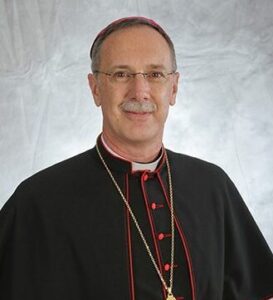
+ Earl Boyea
Bishop of Lansing

Lent – Drawing To A Close

Dear Brothers and Sisters, 

Lent is drawing to a close very quickly and we are focused on the final moments of Jesus’ life on earth. During the last two weeks of Lent, which are traditionally referred to as Passiontide and Holy Week, we hear the Gospel passages of Jesus’ final dialog with those who will not accept the truth that He brings from the Father. As part of His rejection and betrayal by the religious authorities and His own apostle, He willingly surrenders His life in faithfulness to His Father’s will for our salvation. In many of our churches, signs of the Resurrection (statues and other images) are covered to remind us of the sorrow that comes with the betrayal and death of the Savior. We fast from the signs of the Resurrection and meditate on Jesus’ last act of surrender and our own eventual passing as well.

During the Year of St. Joseph, we are considering the moments of his life and mission as head of the Holy Family. Like many times in the Scriptures, St. Joseph is silent during Jesus’ suffering and death. In fact, St. Joseph is completely missing in any account of Jesus’ suffering, death, and Resurrection. Mary is present. Others are present. St. Joseph is gone. Our tradition reminds us that St. Joseph died some time between the finding of Jesus as a child in the Temple at age 12 and the time when Jesus began His public ministry at the age of 30. Those “hidden” years in the life of St. Joseph, outside of special visions given to some Saints and mystics about his life during those years, remains an unrevealed mystery. 

St. Joseph’s absence from Holy Week can show us much of how God works our salvation through death itself. St. Joseph was the head of the Holy Family. The head of a family is charged to be the first to step out into uncharted territory, to make the path clear and safe for other family members to travel, and to show an example of how to make the journey. It was appropriate that St. Joseph was the first to leave this world so that he could show Jesus, by example, on a human level, how to surrender Himself to the Father in death. St. Joseph had always courageously surrendered himself to the Father’s will in every decision he made for himself or for the good of his wife and family. In order to pass through one’s passion and death, every person must do so with faith, courage, and perseverance in God’s grace. St. Joseph persevered through his suffering and death and modeled the virtues of faith, hope, and trust in the salvation promised to him by his own foster-Son. St. Joseph also shows us that if we have faith and stay together as a family through our sufferings, we should not fear sickness, suffering, or death, because our Father in heaven is guiding our family together through this world of suffering to a place where we can be together in joy forever. The tranquility of St. Joseph in his own death certainly helped Jesus and Mary to later persevere through the pain of the Cross. St. Joseph not only showed Jesus and Mary how to persevere through suffering and death, but he also shows us how to do the same. In our tradition, St. Joseph is Patron of the Dying because he lived his life with Jesus and Mary and he died being united in the love of Jesus and Mary. He shows us that if we want to be with Jesus and Mary in heaven, we need to spiritually “walk” with them throughout our lives. He served their needs during his life. We may ask ourselves if we are following and serving Jesus with every bit of strength we have and, if so, are we also doing what Mary asked of us at Cana, “Do whatever He tells you.” How we live our life is how we will die. The Father’s will is for us to die in a spiritual union of faith and love with Jesus and Mary so that our living relationship with them pulls us through to eternal life. St. Joseph went through death in trust that he would soon be reunited in a new resurrected life at the completion of Holy Week. 

The foster-father of Jesus was not inactive, however, during Holy Week. Our tradition tells us that St. Joseph went to join the Holy Souls in the place of the dead (sometimes referred to in the Creed as hell, or in theological language as limbo). Limbo is an appropriate term for the waiting that souls had to endure not knowing exactly when their deliverance to heavenly life would happen.

 St. Joseph brought them the good news that his foster-Son was coming very soon to cleanse them of their sins, to deliver them from their situation, and to lead them to eternal life. It would not be long before Jesus would “descend to the dead” to deliver them. After Mary, St. Joseph is the most just and righteous human being who has ever lived. It is believed that he inherited Original Sin but that he was personally righteous in every moral choice during his life. He therefore also had to await salvation through Jesus’ death and Resurrection with other righteous souls who had lived from the beginning of time in the place of the dead. St. Joseph as Protector and Patron of the universal Catholic Church was already fulfilling that role by ministering to “The Church Suffering” present and waiting in the place of the dead. One might imagine that when Jesus “descended into hell” that he would have delivered his foster-father first when He arrived there to honor him for his faithful care and example during his life on earth. 

In Catholic art, the death of St. Joseph is often portrayed as a close and sacred moment in the life of the Holy Family. Jesus and Mary are seen standing by the bedside of St. Joseph keeping vigil with him for his departure. Just as the Hebrew patriarchs and people stood to eat the Passover meal before their departure from Egypt toward the Promised Land, Mary and Jesus stood in constant prayer asking the Father to help St. Joseph persevere in faith and trust until he would arrive in the Promised Land of Heaven. St. Joseph, Jesus, and Mary teach us and our loved ones how to make our pilgrimage through death to eternal life! 

It is good to ask St. Joseph to pray for us that we will have a peaceful and happy death. We might also spiritually assist others who are dying by making sure that a priest brings Jesus in the Sacraments (In particular, the “last rites” of Confession, Anointing of the Sick, and Viaticum which is the Last Holy Communion) to those who are terminally ill or dying. We might also pray the Rosary and the Litany of St. Joseph in the presence of the dying as they are making their way to eternity. In this way, we will be with Jesus, Mary, and Joseph in life, death, and heavenly glory. 

One of the most beloved hymns to St. Joseph asks for this kind of spiritual assistance from St. Joseph at the time of our own passing. This hymn is thought to have been composed by the Sisters of Notre Dame (de Namur) of Liverpool, England. The first known appearance of the hymn was found in “Convent Hymns and Music” in 1891. It teaches us to prepare for death by living life with Jesus, Mary, and Joseph and to take their attitude about life and death. Properly understood, this hymn teaches us St. Joseph’s Holy Week wisdom about life, suffering, and death: 

Tap here to listen as you follow along with the words below:
Dear St. Joseph, pure and gentle, Guardian of the Savior child, Treading with the virgin mother, Egypt’s deserts rough and wild.

Chorus:
Hail, St. Joseph, spouse of Mary, Blessed above all saints on high, When the death-shades round us gather, Teach, oh, teach us how to die.

He who rested on thy bosom Is by countless saints adored; Prostrate angels in His presence Sing hosannas to their Lord. 

Now to thee no gift refusing, Jesus stoops to hear thy prayer; Then, dear saint, from thy fair dwelling, Give to us a father’s care. 

Dear St. Joseph, kind and loving, Stretch to us a helping hand; Guide us through life’s toils and sorrows Safely to the distant land. 

In the strife of life be near us, And in death, oh, hover nigh, Let our souls on thy sweet bosom To their home of gladness fly. 

Thou hast known a pilgrim’s sorrows, But thy day of toil is o’er; Help us while we journey onward Lead us to the peaceful shore. 

Hail St. Joseph, just and holy, Loving children breathe thy name; Here below, through toil and danger, Love and care from thee we claim. 

May St. Joseph help us and our families to make our passage with Jesus and Mary through our own suffering and death to the shores of the promised Land of Heaven!

In Christ’s Glorious Passion, Fr. Derda,
St. Stanislaus & Sacred Heart Catholic Parish
Dorr, MI

https://www.youtube.com/watch?v=a_pZpUKDUg8&t=75s